Trade · bakery & patisserie

Cold rooms for bakeries and patisseries

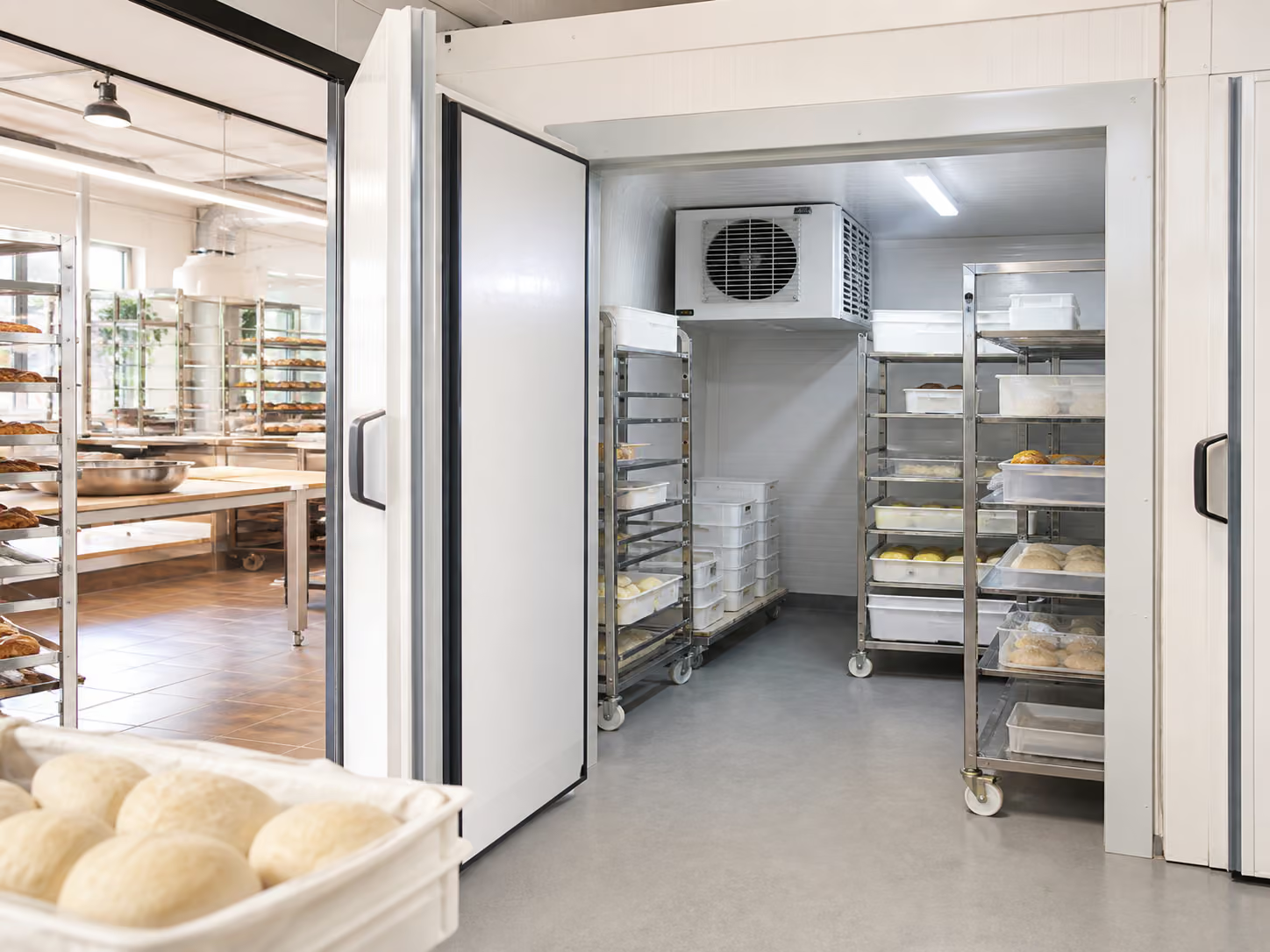
Slow controlled proving, holding prepared dough pieces, frozen viennoiserie before baking, pastry creams and desserts: baking and patisserie need fine, stable temperature bands. Our pre-charged R290 units and Dixell control deliver exactly that.

Photo terrain · Trade · bakery & patisserie

A proving room is not a standard cold room. The baker wants to control the fermentation rate precisely: 4 °C for an 18-hour prove, 12 °C for 8 hours, and so on. The smallest drift changes the dough. Our Dixell control allows a set-point to the half-degree, which is exactly what the professional baker needs.

Key features

What your trade needs

Extended proving band 0 to +14 °C

For the baker's slow prove: range extended to +14 °C (versus +10 °C standard). Dough pieces rest 8–24 hours under controlled temperature.

Food-grade stainless shelving

Fine 30 mm runners for pastry trays (60 × 40 cm). Four levels as standard in a 10 m³, six levels available as an option.

Dedicated freezer zone for viennoiserie

Production bakers often pre-freeze raw viennoiserie at −18 °C for baking on day one or two. Our dual-zone room (positive proving plus negative viennoiserie storage) targets exactly that.

A typical artisan baker set-up

Baker working alone (80–150 kg of bread a day): a 10 m³ positive room with the +14 °C extension for proving, plus a separate chest freezer for viennoiserie stock. Baker-pâtissier (200+ kg a day): a 15–20 m³ dual-zone room — positive at +14 °C for proving and negative at −18 °C for raw viennoiserie, desserts and house-made ices. A larger production workshop: a 30–40 m³ industrial unit.

Controlled proving at +4 °C — the productivity case

Controlled proving has transformed artisan baking over the past 15 years. Mixing the evening before, holding the dough pieces at +4 °C overnight (10–12 hours), then shaping and baking at dawn earns the baker 2–3 hours of sleep and improves the dough as well (slow fermentation gives a more complex flavour). The cold room is the equipment that makes this workflow viable. Without it, you are stuck with direct doughs mixed at 4 a.m.

Questions fréquentes

What is the difference between a proving room and a cold room?

An off-the-shelf 'proving cabinet' is typically a unit run warm at +20 to +25 °C (the warm zone, not the cold one). The professional baker often has both: a cold room at +4 to +14 °C for the long rest, and a warm cabinet at +25 to +30 °C for the final prove just before baking. Our catalogue covers the former (the more structural piece). The warm cabinet is a separate specialist item.

Is the non-slip floor suitable in a flour area?

Yes, though flour naturally clings to any food-grade surface. We recommend a daily hose-down (our T-floor handles this without trouble) plus a removable mat at the door to cut transfer. For very flour-heavy production, consider the 'power-floated concrete floor' option (slightly less slippery when wet than aluminium T-floor).

Un projet précis ? Devis sous 48 h.

Indiquez votre usage, votre volume cible et votre adresse de livraison. Notre équipe technique répond avec une fiche dimensionnée et un prix HT clair, dans les 2 jours ouvrés.