Trade · florists

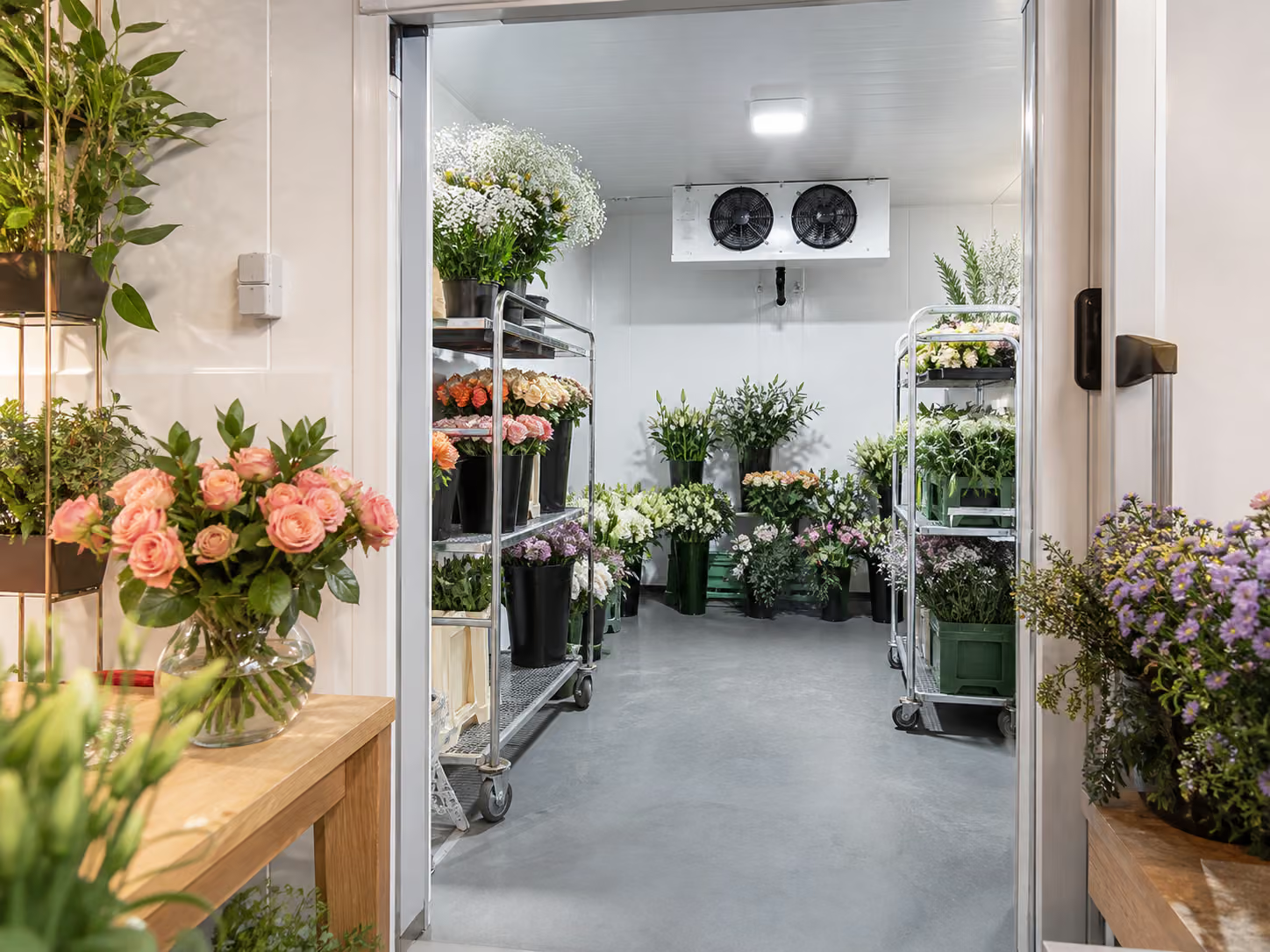
Flower cold rooms — long-life storage of cut flowers

Florists need a very specific room: +4 to +6 °C, 85–90 % relative humidity, soft LED light, and no abrupt swings. Our catalogue includes dedicated configurations with an ultrasonic humidifier and humidity control.

Photo terrain · Trade · florists

Seasonality: Fortes pointes Saint-Valentin (févr.), fête des Mères (mai), Toussaint (oct-nov)

A florist's cold room is not a standard room with a thermostat set to +4 °C. It is a delicate balance of temperature, humidity and light. Too warm and flowers wilt fast. Too cold (an accidental dip below 0 °C) and petals burn. RH too low and petals dry; RH too high and mould develops. Our florist configuration was calibrated with a partner florist over several optimisation cycles.

Key features

What your trade needs

Integrated ultrasonic humidifier

To hold 85–95 % RH without excess condensation. A fine, non-wetting mist with adjustable output and a humidity sensor with set-point.

Neutral 4000 K LED lighting

A daylight-like spectrum that does not distort colour, with variable intensity. Ideal for showing off bouquets while the room is open to the public.

Coupled temperature + humidity control

The standard Dixell controls temperature only. For the florist we swap in a dual temperature + humidity controller (option around +480 € ex VAT) that manages the humidity set-point finely.

Compact 10 m³ prioritised

Most florist shops have under 20 m² of floor space — a 10 m³ fits into 8 m². For wholesale florists: 20–30 m³ with dual zones (fresh stock plus made-up bouquets).

The ideal band by flower type

Roses: +2 to +4 °C / 90 % RH (the most RH-demanding). Tulips: +1 to +2 °C / 85 % RH. Lilies: +4 to +6 °C / 80 % RH. Orchids: +10 to +12 °C / 70 % RH (a different band — plan a separate zone if you stock them regularly). Gerbera: +4 °C / 85 % RH. Anemones: +2 °C / 85 % RH. Foliage (eucalyptus, asparagus fern): +4 °C / 80 % RH. The controller can run two separate set-point zones via a removable partition.

Seasonality: Valentine's Day and Mother's Day

The two peaks of the trade. Valentine's Day: stock 8–12 days ahead, about 3–4 times the usual volume. Mother's Day: an even sharper peak, up to 6 times the usual volume. If your current room is sized for average activity, you will run out of space in those weeks. For growing florists, stepping up from 10 to 15–20 m³ absorbs the peaks without lost sales.

Water use and the humidifier

The ultrasonic humidifier uses about 50 L of water a month to hold 90 % RH in a 10 m³ room. It connects directly to the mains or to a 25 L tank refilled twice a week. Mains water is fine if hardness is below 30°F, otherwise fit an upstream softener (around 250 € ex VAT) to prevent scaling of the nebuliser.

Questions fréquentes

How many bouquets fit in a 10 m³ for Valentine's Day?

With floor buckets plus two stainless shelf levels: 400–500 standard bouquets (12 roses) plus 200–300 mixed bouquets. For very busy florists the 20 m³ is more comfortable and lets you ride the peak without rushing stock rotation.

Does the LED tube give off too much heat for the room?

No, that is the whole advantage of LED over fluorescent. Our standard 24 W LED lighting uses about 50 % less energy and gives off four times less heat. The refrigeration unit copes easily. If you leave the light on all day (shop opening hours), add the optional presence detector to save energy with no change for the customer.

Can the humidifier be added later?

Yes, but it is more economical to include it in the factory build. Fitting after delivery: around 880 € ex VAT installed. Included in the build: around 480 € ex VAT. If you are unsure, take the option at quotation stage — you can always switch it off if you don't use it, but the initial install costs half as much.

Un projet précis ? Devis sous 48 h.

Indiquez votre usage, votre volume cible et votre adresse de livraison. Notre équipe technique répond avec une fiche dimensionnée et un prix HT clair, dans les 2 jours ouvrés.